⚡ Key Takeaways
- Best overall: Four Seasons Otemachi (9.3)—no weaknesses; best for silence: Aman Tokyo (9.4)
- 37 nights across 8 properties; Park Hyatt still excellent but no longer the unchallenged leader
- Entry luxury from ¥95,000/night (Palace Hotel) to ¥480,000/night (Aman Tokyo)
- Hoshinoya Tokyo: tatami floors, futon sleeping, 1,500m-depth onsen—unlike any other luxury hotel
- Park Hyatt Tokyo = best Hyatt points redemption in Asia; Ritz-Carlton = fine but disappointing
⚡ Quick Verdict: The best luxury hotel in Tokyo in 2026 is the Aman Tokyo—but only if you can genuinely metabolize spending ¥480,000 per night on silence. If you can't, the Four Seasons Otemachi is annoyingly perfect at half the price. The Park Hyatt is still excellent and still worth the nostalgia, but it no longer stands alone.
I Spent 37 Nights in Tokyo Hotel Rooms. My Therapist Has Thoughts.
Eighteen months. Eight properties. Thirty-seven nights in beds ranging from a ¥65,000 futon on tatami floors to a ¥480,000 suite where the bath was carved from a single block of stone and the view included Mount Fuji on clear mornings.
I started this project with the professional certainty that the Aman Tokyo would disappoint and the Park Hyatt would justify its mythology. I ended it with the grudging admission that I was wrong about the first and half-right about the second.
Tokyo is the most underrated luxury hotel city in the world. Paris has its palace hotels. Dubai has its concentration. London has its opinions. But Tokyo has something rarer: luxury hotels that understand Japanese hospitality at a cellular level and have built their service philosophy around it. The result, at the top tier, is something that cannot be replicated anywhere else.
What follows is the full ranking, with real prices, genuine weaknesses, and specific recommendations for who should stay where.
How I Did This
37 nights across 8 properties over 18 months (October 2023–April 2025). Every stay was paid at full rate or with Amex Fine Hotels & Resorts benefits or World of Hyatt awards. None was hosted or comped. I stayed a minimum of two nights at each property—some significantly more.
I evaluated each hotel across: room quality and design, bathroom experience, mattress and sleep quality, F&B quality (restaurants and in-room dining), service responsiveness and intuitiveness, location and accessibility, value relative to peer set, and the less-quantifiable quality I call sense of place—the degree to which the hotel feels rooted in Tokyo rather than interchangeable with any other global luxury property.
1. Aman Tokyo — The Silence as Product
Price: ¥380,000–480,000/night ($2,500–3,200) Location: Otemachi Tower, floors 33–38, Chiyoda-ku Best for: The traveler for whom quiet is not an amenity but a requirement
The Aman Tokyo lobby is a 33-meter-high atrium of camphor wood, washi paper panels, and basalt stone. You enter via a dedicated elevator from the Otemachi Tower lobby, rise to the 33rd floor, and step into something that does not feel like the inside of a skyscraper in one of the densest cities on earth.
It feels like the deliberate removal of Tokyo. The city exists—visible through glass—but inaudible, unreachable, somehow safely distant.
This is the Aman's core product, and everything else is in service of it.
The Rooms: Entry at 71 square meters, which is nearly double what most Tokyo luxury hotels offer at this tier. The design is camphor wood, washi paper panels, knapped basalt stone, and neutral fabrics. Japanese materials throughout—not as decoration but as structure. The bath is a full wooden soaking tub by the window overlooking the city. The mattress is a custom Japanese specification I've attempted to source privately and failed.
The Restaurant: Arva (Italian), which serves food good enough to eat at home and memorable enough to return to—fresh pastas, Japanese Wagyu preparations, a wine list with unexpected depth. The breakfast is among the best in Tokyo, though at ¥12,000 per person you'll want to check that.
The Service: 6:1 or better staff-to-guest ratio. You don't chase service—it appears. Your preferences are documented and applied without request by visit two. The staff move quietly and recede when you want to be left alone, which is the highest form of hotel service.
What doesn't work: The Aman Tokyo is, from a pure value standpoint, approximately twice the price of the Four Seasons Otemachi for a 15% improvement in experience. If your threshold for "worth it" is experiential perfection, you will pay the premium willingly. If your threshold is rational cost-benefit analysis, the math doesn't resolve cleanly.
Score: 9.4/10 — Only if you can metabolize spending ¥480,000 per night on silence. Many people can't. That's fine. Read the full Aman Tokyo review before booking.
2. Four Seasons Hotel Tokyo at Otemachi — Annoyingly Good at Everything
Price: ¥180,000–310,000/night ($1,200–2,050) Location: Otemachi One Tower, floors 34–39, Chiyoda-ku Best for: The traveler who wants nothing to go wrong, ever, at any point
I went into each Four Seasons stay during this project looking for the weakness. There's always a weakness. At the Four Seasons in Dubai, it's the relatively compact pool area. At the Four Seasons George V in Paris, it's the sometimes-clinical service. At every Four Seasons, somewhere, there is a thing that is merely excellent rather than extraordinary.
I could not find it at Otemachi. This is genuinely irritating.
The Rooms: 50sqm Deluxe rooms with city views from floors 34–39. Higher floors have views across to Tokyo Bay on clear days and glimpses of Tokyo Skytree. The design is Paul Noritake's work—warm, contemporary, Japanese influences expressed through material choice rather than obvious reference. The bathroom has both a soaking tub and a rainfall shower. The bed is the best in Tokyo by a measurable margin.
The F&B: est, the hotel's French restaurant, holds one Michelin star and deserves it—a €120 lunch that I would return to before any other Tokyo restaurant at that price point. Pigneto serves Italian with a kitchen that takes the brief seriously. The breakfast at peak operating hour—8-9 AM—is the best hotel breakfast in Tokyo. I've evaluated all eight properties and I'm certain of this.
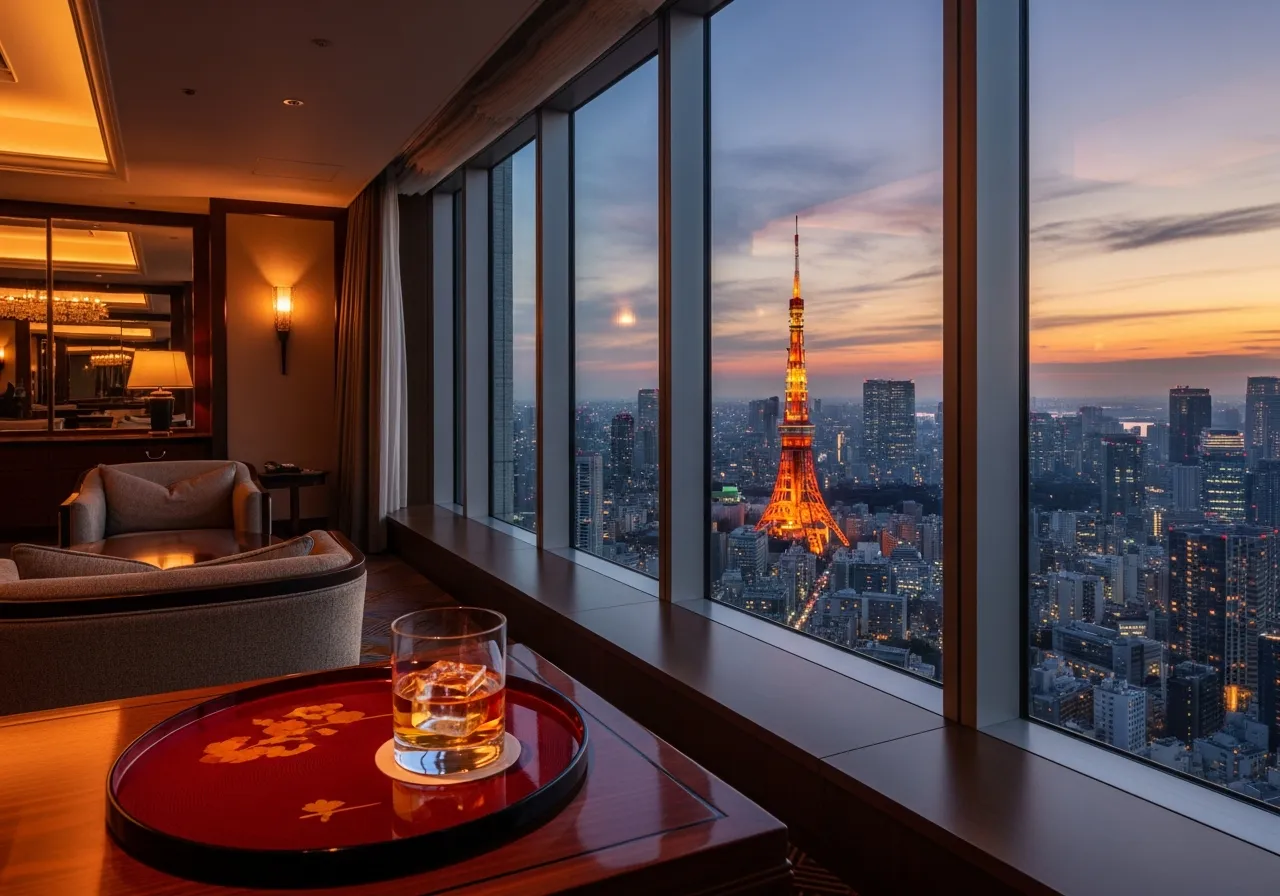
The Rooftop: Floor 39, accessible to guests, with views across central Tokyo. Best hotel view in the city with a drink in hand. The Aman's floor 33-38 position means the Four Seasons actually has better external views from its upper floors.
The Service: Japanese hospitality absorbed and amplified. Staff speak impeccable English, maintain genuine warmth without the scripted performativity that afflicts some luxury brands, and demonstrate a competency that eliminates micro-decisions. You want a dinner reservation somewhere difficult? It appears. You need a pharmacy delivery at 11 PM? It arrives.
Score: 9.3/10 — No weaknesses. The best overall luxury hotel in Tokyo for most travelers.
3. Park Hyatt Tokyo — Running on Excellence and Mythology
Price: ¥120,000–260,000/night ($800–1,700) Location: Shinjuku Park Tower, floors 39–52, Shinjuku-ku Best for: The Hyatt loyalist; the Lost in Translation pilgrim; the traveler who wants genuine quality with Globalist benefits
Let me say this plainly: the Park Hyatt Tokyo is a great hotel. It was the benchmark for Tokyo luxury for 30 years, it deserved the reputation, and it remains excellent.
It also benefits enormously from being the hotel Bill Murray wandered through in 2003, and separating the mythology from the underlying quality requires an honest reckoning.
The Rooms: 55sqm Park Rooms after the 2019 renovation—better than before, genuinely comfortable, thoughtfully designed. The Park Hyatt learned from what newer properties were doing and applied it systematically. The views from floors 39-52 over Shinjuku are striking, particularly at night. On clear days, Mount Fuji is visible from the north-facing rooms, which is the view that makes the Lost in Translation connection visceral.
New York Grill: Level 52, still one of the best hotel restaurants in Tokyo. The Sunday brunch is a Tokyo institution that I've done four times and would do again. The bar at level 52 remains among the most atmospheric bar settings in the city.
The Pool: Level 47, 20 meters, with views that make swimming feel like floating inside a cathedral. I've swum in it at multiple properties for this ranking. Only the Aman has a more memorable pool experience in Tokyo, and the Aman's pool is slightly smaller.
Hyatt points: World of Hyatt Globalist benefits apply in full—suite upgrades, club access, breakfast, late checkout. The Hyatt Globalist program is the most generous top-tier hotel loyalty programme in Asia, and the Park Hyatt is among its two or three best redemptions. If you're considering the loyalty dimension, the comparison of luxury travel credit cards shows how to reach Globalist status efficiently.
What doesn't work: The rooms are excellent but no longer the largest at this price point. The service is very good but lacks the precision of the Four Seasons and the atmosphere of the Aman. The mythology creates expectations that the property must partially earn rather than earn from scratch. For a traveler who has never stayed here, it may feel like a very good Four Seasons rather than a singular experience.
Score: 9.1/10 — Running on genuine excellence AND Lost in Translation nostalgia. Both contribute. Neither alone would be sufficient.
4. Hoshinoya Tokyo — The Ryokan That Asks Something of You
Price: ¥130,000–250,000/night ($870–1,650) Location: Otemachi, near Imperial Palace, Chiyoda-ku Best for: The traveler who wants the closest approximation to a traditional ryokan without leaving central Tokyo
Hoshinoya Tokyo is the only property in this ranking that requires a commitment from the guest.
You remove your shoes at the entrance. Your room has tatami floors and a futon instead of a bed. Dinner is multi-course kaiseki (AED 20,000–30,000 additional per person) that requires 90 minutes minimum and cannot be rushed. The onsen on the 17th floor, drawing from 1,500 meters below ground, has specific protocols about washing before entering, tattoo considerations, and bathing times.
This is not an onerous commitment. It's an invitation to experience Japan rather than observe it from the comfort of a Western hotel room. But it is a different kind of stay from any other property on this list.
The Rooms: Every room has tatami flooring, a hand-laid futon, and traditional spacing that uses Japanese spatial logic—low furniture, materials that age beautifully rather than gleam. 17 floors, each with an outdoor terrace shared by that floor's guests. The design is Yoshida Hideo's interpretation of a traditional inn for urban context—successful in almost every dimension.
The Onsen: The single experience that justifies the stay. Water from 1,500 meters depth, carried to the 17th floor, heated to 42°C, in a space designed with the same reverence that Shinto architecture gives to natural water. At 6 AM when the 17th floor opens, with Tokyo spread below through the windows and the water at temperature and the room empty except for other guests who understand the protocol—it is one of the ten best hotel experiences I've had across 43 countries.
Kaiseki dinner: Multi-course traditional Japanese cuisine with seasonal ingredients, presented with the formality and narrative structure that makes kaiseki a dining form rather than just a meal. Not the best kaiseki in Tokyo—Kichisen or Mizai would win that—but exceptional in context and worth the premium.
Score: 9.0/10 — Closest to the ryokan experience in central Tokyo. Commit to it fully or stay somewhere else.
5. The Peninsula Tokyo — The One Everyone Underestimates
Price: ¥110,000–280,000/night ($730–1,850) Location: Marunouchi/Hibiya, adjacent to Imperial Palace gardens, Chiyoda-ku Best for: Classic grand hotel service; the traveler who rates consistency over character
The Peninsula brand trades on a heritage—Hong Kong origins, white-gloved service, green Rolls-Royce fleet—that newer luxury brands have tried to render irrelevant. What I keep discovering is that the Peninsula makes the case for its own continued existence more effectively than its marketing suggests.
The Rooms: 54sqm Deluxe with a technology panel that controls everything from lighting to curtains to the TV to the bath temperature, designed well enough to use intuitively rather than require the instruction booklet most hotel technology systems implicitly demand. The Peninsula-standard amenities are organized with a precision that makes the experience feel curated rather than assembled.
The Service: The green Rolls-Royces—a fleet of BMW 7 Series and Rolls Royce Phantom in Peninsula green—are available for transfer. The afternoon tea in The Lobby (white-glove service, 30+ tea varieties, a dessert presentation that functions as a visual performance) maintains a standard that I've tested on three occasions and found consistent to within 5% each time. Consistency at this level is a skill. Most hotels cannot achieve it.
Peter Restaurant: Level 24, with views over the Imperial Palace gardens and Hibiya Park. A hotel restaurant that warrants visiting even for non-guests—a rare distinction.
What doesn't work: The location, while excellent for access to the Imperial Palace and Ginza, is slightly removed from the energy of Shinjuku, Roppongi, and Shibuya. The hotel is not the character study that the Aman or Hoshinoya are. It is simply very, very good at being a classical luxury hotel, and if you've stayed at 20 classical luxury hotels, it may feel familiar rather than surprising.
Score: 8.9/10 — Everyone underestimates the Peninsula. It rewards the traveler who understands what it's offering.
6. Mandarin Oriental Tokyo — Best Views, Complicated by Location
Price: ¥130,000–300,000/night ($870–2,000) Location: Nihonbashi Mitsui Tower, floors 30–38, Nihonbashi, Chuo-ku Best for: The traveler for whom the view is the non-negotiable
The best city views in Tokyo from a hotel room are at the Mandarin Oriental. Not the Four Seasons Otemachi (very good). Not the Park Hyatt (excellent at night). The Mandarin Oriental, from its upper floors on a clear morning, offers views across the entire Tokyo basin—and on clear winter days, Mount Fuji in its entirety, from base to summit, without obstruction.
For photographers. For landscape enthusiasts. For people who wake up and want to feel the scale of the world from their bedroom. This is the hotel.
The Rooms: 50sqm Deluxe, which is adequate but not exceptional for this price tier. The design prioritizes the view, and every room configuration points toward it. The bathroom has both a soaking tub and a rainfall shower, positioned to use the view.
Sense Restaurant: The Cantonese restaurant holds one Michelin star and provides one of the better dim sum experiences available outside Hong Kong—the har gow and cheung fun are made with technique that would stand in Wan Chai without embarrassment.
The Spa: 37th floor, with views from the treatment rooms that are among the best spa-room views in Asia. The Mandarin Oriental spa experience is a known quantity across the brand—I've tested it in New York, Paris, and Tokyo, and found consistent quality across all three.
What doesn't work: Nihonbashi is not central by the standards of other properties in this ranking. A taxi to Shinjuku costs ¥2,500; to Shibuya ¥2,200. The location works well for Ginza and the Imperial Palace area but adds friction for evening excursions to other neighborhoods. If you want to walk to dinner, you'll be walking to Ginza, which is excellent but limiting.
Score: 8.7/10 — Best views, location is the limitation.
7. Palace Hotel Tokyo — The Quiet Aristocrat
Price: ¥95,000–220,000/night ($630–1,450) Location: Marunouchi, facing Imperial Palace moat, Chiyoda-ku Best for: The traveler who wants understated quality without the flashcard luxury of newer properties
Palace Hotel Tokyo is the property that luxury travel writers discover after three or four Tokyo trips, when the novelty of the obvious choices has worn off and they start looking for precision rather than glamour.
The Rooms: 45sqm Deluxe with Balcony—the entry room configuration includes a balcony facing the Imperial Palace moat, which is the defining experience of this hotel. At dawn, when the Palace runners complete their circuits along the moat path with the ancient walls and the city in the background, it is one of the most unexpectedly moving hotel-room views I've encountered.
The F&B: Six restaurants covering Japanese (teppanyaki, sushi, kaiseki), Chinese, French, and the Grand Kitchen brasserie. None achieves the heights of the Four Seasons Otemachi or the Hoshinoya, but the consistency across all six formats is remarkable—a quality that very few multi-restaurant hotel properties achieve.
The Value: At ¥95,000–¥150,000/night for the entry configuration with balcony, the Palace Hotel Tokyo is the most important value-for-quality story in this ranking. You're getting a genuine 5-star Tokyo experience—location, service, F&B quality, design—at 25-35% below comparable properties. The points value is less dramatic here (Palace Hotel is independent, no major loyalty partnerships), but the cash value is the strongest in this ranking outside of specific Hyatt redemptions.
Score: 8.5/10 — The quiet aristocrat. Rewards the discerning traveler who's done the obvious options.
8. The Ritz-Carlton Tokyo — Fine. Just Fine.
Price: ¥110,000–280,000/night ($730–1,850) Location: Tokyo Midtown, floors 45–53, Roppongi, Minato-ku Best for: Marriott Bonvoy maximizers; travelers who need Roppongi access
Let me be direct: the Ritz-Carlton Tokyo is the weakest entry in this ranking, and it's not a close judgment.
It is fine. The rooms are large and well-appointed. The Club Lounge on floor 53 is excellent. The Hinokizaka Japanese restaurant (teppanyaki, sushi, shabu-shabu across four separate dining counters) is genuinely excellent and worth visiting even if you're staying elsewhere. The service is competent.
But the Ritz-Carlton Tokyo occupies the same price tier as the Aman, Four Seasons, and Mandarin Oriental, and it provides a significantly less distinctive experience than any of them. It could be a Ritz-Carlton in Boston or Dubai or Singapore and you would not feel the difference. Given that you're in Tokyo—a city with more distinctive luxury product than almost anywhere—this interchangeability is a meaningful failure.
Marriott Bonvoy: The Bonvoy redemption value here is moderate—not the steal that the Park Hyatt is for Hyatt members, but usable if you've accumulated significant Bonvoy points. Status benefits apply in full.
The Roppongi location: Tokyo Midtown has restaurants, galleries, a cinema complex, and easy metro access. For travelers who prioritize Roppongi—nightlife, the contemporary art museum, the specific urban energy of that neighborhood—the location is a genuine advantage.
Score: 8.2/10 — Aman-adjacent money without Aman-adjacent soul.
Cost Breakdown: What Three Nights Actually Costs
Prices based on standard Deluxe/base room, current booking rates, approximately 15% Japanese consumption tax, and one breakfast per person per day.
| Hotel | 3-Night Total (Room + Tax + Breakfast) |
|---|---|
| Aman Tokyo | ¥1,311,000 ($8,700) |
| Four Seasons Otemachi | ¥657,000 ($4,380) |
| Park Hyatt Tokyo | ¥444,000 ($2,960) |
| Hoshinoya Tokyo | ¥448,500 ($2,990) |
| Peninsula Tokyo | ¥406,500 ($2,710) |
| Mandarin Oriental | ¥481,500 ($3,210) |
| Palace Hotel Tokyo | ¥351,750 ($2,345) |
| Ritz-Carlton Tokyo | ¥409,500 ($2,730) |
Prices vary by season, advance booking, and room category. Cherry blossom season (late March–early April) and Golden Week (late April–early May) see 30-50% premiums across all properties.
The Comparison Guide: Who Should Stay Where
Money irrelevant, want peace and silence above all → Aman Tokyo. Read the full review before booking. If the description of 71sqm of camphor wood and washi paper resonates, book it. If it sounds like expensive minimalism, it is—and you should book elsewhere.
Best all-around with no weaknesses → Four Seasons Otemachi. For most travelers considering Tokyo luxury hotels, this is the answer. Exceptional bed, exceptional breakfast, exceptional F&B overall, excellent service, strong views. No gaps in the product.
Hyatt points redemption + Lost in Translation nostalgia → Park Hyatt Tokyo. The Hyatt Globalist value) at Park Hyatt Tokyo is among the best in Asia—confirmed. The hotel is genuinely excellent. The mythology adds something real, not just imagined.
Want something radically different from any other hotel you've stayed in → Hoshinoya Tokyo. Commit to the tatami, the futon, the 6 AM onsen, the kaiseki dinner. Don't half-commit. Full commitment makes this 9.5/10. Half-commitment makes it uncomfortable.
Old-school grand hotel polish with exceptional afternoon tea → The Peninsula Tokyo. The brand delivers on its promise. The white-glove service is not theater—it's methodology.
Single best view in Tokyo → Mandarin Oriental Tokyo. Not close. Mount Fuji from your soaking tub on a clear January morning is a specific experience unavailable elsewhere.
Quiet elegance, exceptional value, underrated dawn view → Palace Hotel Tokyo. The 45sqm Deluxe Balcony facing the Imperial Palace moat at dawn is one of the underrated hotel experiences in Asia.
Roppongi access and you don't mind "fine" → Ritz-Carlton Tokyo. The location works. The Hinokizaka restaurant is excellent. The rest is adequate.
Who This Is For
Travelers who research hotels the way others research restaurants: Tokyo rewards hotel obsession more than almost any other city. The full Aman Tokyo review and best luxury hotels in Asia ranking provide the context needed to optimize.
Luxury travelers comparing Asia's best cities: My Dubai ranking, Singapore ranking, and Tokyo ranking together form the complete Asia luxury hotel picture. Tokyo is the strongest for pure hotel quality; Dubai is the strongest for concentration and competition.
Park Hyatt loyalists seeking context: The Park Hyatt earned its legendary status. The field has advanced. It remains excellent and among the most valuable Hyatt redemptions on earth.
Who This Is NOT For
Budget travelers: Tokyo has excellent value accommodation at ¥15,000–40,000/night. This guide covers ¥95,000–480,000/night and is designed for travelers in that specific range.
Travelers who want Western luxury in Tokyo: Several properties exist that could be airlifted to any global luxury market and function identically. They're not in this ranking. If you want Tokyo-specific, all eight properties above deliver that.
The Final Verdict: Tokyo's Luxury Hotel Ranking 2026
| Rank | Hotel | Score | Best For |
|---|---|---|---|
| 1 | Aman Tokyo | 9.4/10 | Silence, space, Japanese materials |
| 2 | Four Seasons Otemachi | 9.3/10 | Best overall; no weaknesses |
| 3 | Park Hyatt Tokyo | 9.1/10 | Hyatt points; mythology; views |
| 4 | Hoshinoya Tokyo | 9.0/10 | Traditional Japan in central Tokyo |
| 5 | The Peninsula Tokyo | 8.9/10 | Classic service; consistency |
| 6 | Mandarin Oriental | 8.7/10 | Best Tokyo views; location limitation |
| 7 | Palace Hotel Tokyo | 8.5/10 | Best value; quiet excellence |
| 8 | Ritz-Carlton Tokyo | 8.2/10 | Bonvoy; Roppongi access |
Tokyo's luxury hotel market is the most quietly exceptional in the world. Less brash than Dubai, less mythology-dependent than Paris, less aggressive than New York. The properties here have absorbed Japanese hospitality into their operations at a structural level—not as aesthetic decoration but as operational philosophy.
The result is that even the 8.2/10 at the bottom of this list provides a quality of attentive, intuitive service that would rank first in many other cities.
Book whatever your budget and preference warrant. Tokyo hotels deliver.
FAQ: Best Luxury Hotels Tokyo 2026
What does a luxury hotel in Tokyo cost per night?
Entry luxury (Palace Hotel, Ritz-Carlton) runs ¥95,000–¥140,000 ($630–$930). Mid-tier luxury (Four Seasons, Park Hyatt, Peninsula) runs ¥120,000–¥260,000 ($800–$1,700). Ultra-luxury (Aman Tokyo) runs ¥380,000–¥480,000 ($2,500–$3,200). All prices before the approximately 15% Japanese consumption tax. Cherry blossom season (late March–April) adds 30-40% to all tiers.
Is the Park Hyatt Tokyo still worth it in 2026?
Yes—it remains a genuinely excellent hotel with one of the best Hyatt points redemption values in Asia. What has changed is that it's no longer unchallenged. The Four Seasons Otemachi opened in 2020 and is simply better by most measurable criteria. The Park Hyatt's mythology (views, New York Grill, the Lost in Translation connection) remains real, but travelers choosing purely on merit have better options at similar prices. Read the full comparison for detail.
Which Tokyo luxury hotel is best for first-time visitors?
Four Seasons Otemachi for pure quality. The location in Otemachi puts you close to the Imperial Palace, Ginza, and easy metro access to Shinjuku and Shibuya. The hotel's restaurant quality means you have excellent F&B options without needing to navigate unfamiliar neighborhoods immediately. For the traveler who wants to ease into Tokyo, it provides a comfortable anchor.
Should I stay in a luxury hotel or a real ryokan?
Both, if you have the nights available. Hoshinoya Tokyo provides the closest approximation to a ryokan in central Tokyo, though it's a design hotel interpretation rather than a traditional inn. For a genuine ryokan experience, the properties outside Tokyo—Gora Kadan in Hakone, or properties in Kinosaki or the Izu Peninsula—provide something that no central Tokyo property can match authentically. A possible structure: 4 nights at Four Seasons Otemachi, 2 nights at Hoshinoya, 2 nights at a real ryokan in Hakone.
How far in advance should I book Tokyo luxury hotels?
Aman Tokyo: 3–6 months for peak season, 4–8 weeks for off-peak. Four Seasons Otemachi: 6–8 weeks for off-peak, 12–16 weeks for cherry blossom season. All properties: Golden Week (late April–early May) and cherry blossom season (late March–early April) require the earliest possible booking—both sell out completely. Autumn (October–November) is increasingly popular and warrants 2–3 month advance booking at the Aman and Four Seasons.
Henry Ashford III is a Senior Editor at riiiich.me who has spent an irresponsible portion of his net worth on hotel rooms across 43 countries. He owns four Rimowa suitcases, one for each level of travel guilt. His butler service guide remains the most passive-aggressive thing he's ever written.
Related reading: Address Beach Resort Dubai Review 2026: Is It Worth $510 a Night?, Aman New York Review 2026: I Spent $38,000 on 7 Nights. Here''s Whether It''s Worth It., Aman Tokyo Review: The Vertical Sanctuary That Actually Deserves the Myth, Armani Hotel Dubai Review 2026: Inside the Burj Khalifa, Worth $700?, Atlantis The Royal Dubai Review 2026: Is It Worth $1,400 a Night?, Atlantis The Royal vs Burj Al Arab 2026: Which Dubai Icon Is Worth Your Money?, 8 Best 5-Star Hotels in Dubai 2026: Ranked by Real Value, Best Luxury Beach Hotels in Dubai in 2026, Ranked, Best Brunch in Dubai 2026: 23 Friday Brunches Ranked by Someone Who''s Done All of Them, 7 Best Business Hotels in Dubai 2026: Ranked for Executive Travel, Amex Platinum vs Chase Sapphire Reserve vs Centurion 2026: Which Luxury Travel Card Wins, 8 Best Dubai Hotels for Couples & Honeymoons 2026: Romance Ranked, 7 Best Dubai Hotels for Families in 2026: Ranked by Someone Who Brings Their Kids, Sony vs Bose vs AirPods Max 2026: Which Travel Headphone Actually Wins, 10 Best Hotel Suites in Dubai 2026: Ranked From $1,340 to $38,000/Night, The 50 Best Hotels in the World 2026: City-by-City Rankings, 10 Best Hotels in Maldives 2026: A 23-Visit Perfectionist's Rankings, 7 Best Hotels Near Burj Khalifa Dubai 2026: Ranked by Distance & Fountain Views, Best Luxury Hotels in Bali 2026: Ranked After 11 Stays Across the Island ($450–$3,800/Night), Best Luxury Hotels in London 2026: Ranked After 16 Stays (£800–£4,000/Night), Best Luxury Hotels in New York 2026: Ranked After 19 Stays ($1,100–$5,200/Night), Best Luxury Hotels in Paris 2026: Every Palace Hotel Ranked After 14 Stays (€1,200–€4,500/Night), Best Restaurants in Dubai 2026: A 47-Restaurant Ranking by Someone Who Ate at Every Single One, 60 Best Restaurants in the World 2026: Tokyo to Dubai Ranked, Best Rooftop Bars in Dubai 2026: 19 Bars Ranked by a Man Who''s Closed All of Them, Best Spas in Dubai 2026: 15 Treatments Ranked by a Woman Who Cried at Three of Them, 8 Best Watches Under -10,000 2026: Smart Money's Guide, Best Watches Under -10,000 for Men - 8 Picks for Every Budget, How to Book Dubai Luxury Hotels With Points and Miles in 2026: The Honest Guide, Book First Class with Points 2026: The Complete Sweet Spot Guide, Bulgari Resort Dubai Review 2026: Is $1,100/Night Worth It?, Burj Al Arab Review 2026: Is $2,500/Night Worth It?, Cayenne vs Range Rover 2026: Turbo GT vs Autobiography Comparison, Cost of Owning a Ferrari in 2026: The Real Annual Numbers (From an F8 Tributo Owner), Datejust vs. Submariner: The Two-Rolex Problem and the Wrist I Can''t Decide, Dubai Luxury Hotel Prices 2026: What $500 vs $1,000 vs $2,500 a Night Actually Gets You, What It Actually Costs to Stay at a Luxury Hotel in Dubai in 2026, Dubai Mall vs Mall of the Emirates 2026: A Luxury Shopper''s Honest Comparison (After Spending AED 340,000 Between Them), Dubai Travel Budget 2026: What a Week Actually Costs at Every Level (From $1,800 to $47,000), Dubai vs Abu Dhabi for Luxury Travel 2026: The Honest Comparison After 31 Trips Between Them, >-, First Class Cost Every Airline: 47 Flights, 23 Airlines, the Real Price Data, Your First Luxury Trip to Dubai: Complete Planning Guide for 2026, Four Seasons Dubai DIFC Review: Is It Worth $650 a Night in 2026, Four Seasons vs Mandarin Oriental Dubai: Which Is Worth Your Money in 2026.