⚡ Key Takeaways
- Still top-three in Tokyo (9.1/10)—the pool, the New York Bar, 30 years of character that newer hotels can't replicate
- The 47th-floor pool is the most beautiful hotel pool in the world—not for size or views, but for the quality of light
- New York Bar from Lost in Translation is the real thing—go Tuesday/Wednesday after 10 PM to find the atmosphere, not the tourists
- Hyatt Globalist: 40,000–50,000 points/night, one of the best luxury redemptions in the entire Hyatt portfolio
- Aman Tokyo is 2.5x the price for more immersion; Four Seasons Otemachi is newer and more polished—Park Hyatt has neither beat, but has something neither has
⚡ QUICK VERDICT
The Park Hyatt Tokyo is still a top-three luxury hotel in the city—but not because of the movie. It's because a 55-square-meter room on the 45th floor of Shinjuku Park Tower, with Mount Fuji visible through morning cloud on a clear day, remains one of the most quietly thrilling hotel experiences in Asia. The New York Grill is still exceptional. The pool is still transcendent. The jazz is still real. What's changed is the competition—the Four Seasons Otemachi and the Aman Tokyo have arrived, and the Park Hyatt now occupies a position that's less "unchallenged best" and more "beloved institution navigating relevance." It's navigating beautifully. But it's navigating.
A Note on Nostalgia, Before We Begin
I should tell you something about myself and this hotel, because it will explain everything that follows and also because Eleanor Vance doesn't write reviews without telling you something about herself first, which is either transparency or narcissism and I've decided it's both.
I first stayed at the Park Hyatt Tokyo in 2009. I was twenty-six, recently divorced from a brief and inadvisable marriage, and spending money I didn't have on a trip to a city I'd never visited because a therapist had told me I needed to "go somewhere that has nothing to do with your life" and because I'd watched Lost in Translation fourteen times during the separation proceedings and had developed the delusional conviction that if I could just sit in that bar on the 52nd floor with a glass of Suntory whisky and the Tokyo skyline doing its thing, something inside me would rearrange.
Reader: something inside me rearranged.
Whether it was the hotel or the whisky or Tokyo itself or the simple therapeutic fact of being alone in a city where no one knew my name or my recent legal filings, I can't say with certainty. What I can say is that the Park Hyatt Tokyo became, for me, a fixed point—the hotel I return to when I need to remember that the world is larger than whatever I'm currently anxious about, which is always something, and which in 2026 is usually whether luxury travel journalism is a defensible career or an elaborate coping mechanism with an expense account.
I've stayed four times now. Twice since the 2019 renovation. The hotel has changed. I've changed. Tokyo has changed. The question this review needs to answer is whether the Park Hyatt Tokyo—stripped of the Coppola mythology, stripped of my personal mythology, stripped of every projection that every lonely traveler has placed on this building since 2003—is still worth your money.
The answer is yes.
But the "yes" is more complicated than it used to be, and I owe you the complications.
The Building: 177 Meters of Kenzo Tange, Still Standing
The Park Hyatt Tokyo occupies floors 39 through 52 of the Shinjuku Park Tower, designed by Kenzo Tange and completed in 1994. Tange—who also designed the Tokyo Olympic stadium, Hiroshima Peace Memorial, and various other buildings that make other architects feel inadequate—created a triple-spired granite tower that's simultaneously monumental and restrained, which is the architectural equivalent of speaking softly while being seven feet tall.
The hotel itself was designed by John Morford, with interiors by the Tokyo office of Tange Associates, and the design philosophy is one I'd describe as "Japanese modernism for people who find Japanese minimalism too easy." The public spaces use stone, steel, and wood in combinations that feel warm without being soft—sandstone walls, dark timber beams, the famous George Nakashima-inspired furniture in the lobby that makes you want to sit very still and think about grain patterns. The lighting is low and golden. The ceilings are high. The ambient sound is near-zero.
The 2019 renovation—overseen by the original design team with input from Super Potato (the legendary Tokyo design studio that also created the Park Hyatt Shanghai and various other properties I've written about at probably excessive length)—refreshed the rooms and suites without altering the architectural DNA. This was the correct decision. Hotels that renovate by erasure—gutting what made them distinctive and replacing it with whatever Architectural Digest is currently promoting—are committing a form of institutional self-harm that I find both common and depressing. The Park Hyatt didn't do this. They updated the technology, refreshed the bathrooms, replaced soft furnishings that had absorbed twenty-five years of global traveler energy, and left everything else alone.
The result is a hotel that feels both 1994 and 2026—a temporal duality that works because the 1994 design was good enough to survive thirty years without looking dated, which is the highest compliment I can pay to any interior.
The Room: Park Room, 45th Floor, 55 Square Meters of Considered Silence
I've stayed in three room categories at the Park Hyatt Tokyo: the Park Room (55 sqm, twice), the Park Deluxe Room (55 sqm, corner, once), and the Park Suite (100 sqm, once, on a birthday, with the specific self-indulgence that birthdays in foreign cities permit). For this review, I'm focusing on the Park Room because it's the category most guests will book, and because the Park Room is where the hotel's design argument is made most clearly: can 55 square meters contain everything you need without making you feel contained?
Yes.
The room is rectangular, high-ceilinged, and organized along a single axis: entry, bathroom, sleeping area, window. The progression from door to view is linear and controlled—you move through a dressing area (fitted wardrobes in dark timber, drawers that close with the hydraulic whisper of Japanese engineering), past the bathroom (visible through a glass partition, which is either erotically adventurous or architecturally practical depending on who you're traveling with and how you feel about them), and into the main room, where the bed—king, set on a low platform, dressed in Egyptian cotton that the hotel has sourced from the same supplier since opening—faces floor-to-ceiling windows that present Tokyo as a vertical landscape.
The view. I need to talk about the view.
From the 45th floor, facing west, Shinjuku's skyline fills the middle distance—a forest of glass and steel that's chaotic at street level and ordered from above, the way cities always are when you're high enough to see their logic. On a clear day—and clear days in Tokyo are seasonal, concentrated in autumn and winter, which is why the best time to visit Tokyo is October through December if views matter to you—Mount Fuji appears on the horizon like a hallucination: perfect, symmetrical, impossibly distant, and so beautiful that the first time I saw it from this room I said "oh" out loud to no one, which is the kind of involuntary response that justifies the price of a hotel room more definitively than any review I could write.
On an unclear day—which is most days from May through September—the skyline fades into haze and the room becomes about interior comfort rather than exterior spectacle. This is fine. The room handles it. The materials are warm. The lighting system offers four preset scenes (I use "relax" exclusively; "bright" is for people who want to see themselves, which I don't always). The minibar is stocked with Suntory whisky, Japanese craft beer, and a selection of rice crackers that I ate in their entirety on my third stay and felt no guilt about, because minibar rice crackers consumed at midnight in Tokyo are one of the genuine pleasures of being alive.
The bathroom is where the renovation is most visible. The original design—functional, granite-heavy, solid—has been softened: the tub is deeper and repositioned by the window (the glass partition between bathroom and bedroom can be screened for privacy, a feature I ignored because I was alone and because the view from the tub is too good to block). The rain shower is excellent—consistent pressure, consistent temperature, the kind of shower where you stand for five minutes longer than necessary because the water is doing something good for your nervous system. The toiletry program is by Aigner (a departure from the old Pharmacopia amenities that long-time guests will notice), and the quality is fine without being memorable. The Aman Tokyo uses its own line. The Four Seasons Otemachi uses Byredo. The Park Hyatt uses Aigner. This tells you nothing important and everything tonal.
The New York Grill and Bar: The 52nd Floor, Where Everything Happens
Let me separate the restaurant from the bar, because they occupy the same floor but serve different functions in the hotel's ecosystem, and because most reviews conflate them in ways that don't serve you.
The New York Grill
The New York Grill is on the 52nd floor of the Shinjuku Park Tower, and it has been, since 1994, one of the great hotel restaurants in Asia. Not because the food is the most technically ambitious in Tokyo—it isn't; the Aman's Arva and the Four Seasons' est both push harder on culinary creativity—but because the New York Grill understands something that most hotel restaurants don't: the room is the meal.
The room is double-height. The ceiling is a steel-and-glass grid that filters natural light during the day and exposes the Tokyo sky at night. The view—south and west, toward the sprawl of Shibuya and Shinjuku and, on clear nights, the distant sparkle of Yokohama—is floor-to-ceiling and overwhelming in a way that's specifically designed to make you feel small and lucky, which are two feelings that I think should accompany expensive steak more often than they do.
The menu is New York steakhouse-meets-Tokyo precision: dry-aged beef, fresh seafood, a raw bar, and the kind of perfectly executed side dishes (creamed spinach, roasted mushrooms, a potato gratin that I've ordered four times and never regretted) that suggest the kitchen takes the supporting cast as seriously as the leads. The wine list is one of the deepest in Tokyo—French-heavy, with a California section that's better than you'd expect and a Japanese wine section that's better than it needs to be.
Dinner for two with wine runs ¥45,000–¥70,000 ($300–$470), which is expensive by any standard and reasonable by Tokyo fine-dining standards and cheap relative to the comparable experience at the Aman New York (where a similar dinner at Arva costs $600+).
Lunch is the secret weapon. The lunch prix fixe—¥8,500 ($57) for an appetizer, main, and dessert, with the same view and the same room—is one of the genuine bargains in luxury Tokyo. I've recommended it to friends who balked at the dinner price, and every one of them has subsequently booked a room. The lunch is the hotel's gateway drug.
Sunday brunch, for the completists, is ¥15,000 ($100) and includes champagne. The brunch crowd is Tokyo's expat elite mixed with visiting business executives and the occasional table of enthusiastic tourists recreating the movie scene, which the staff handle with a patience that deserves its own humanitarian award.
The New York Bar
The New York Bar. The bar. The bar.
This is the room from the film. The room where Bill Murray and Scarlett Johansson sat in separate shots that were edited to feel simultaneous, accompanied by a jazz quartet and the Tokyo skyline and the particular melancholy of two people who were probably not going to sleep together but were definitely going to change each other, which is the narrative structure of the hotel bar itself: a room designed not for resolution but for possibility.
I've been coming here for fifteen years, and the bar has evolved in ways that track the hotel's broader trajectory. The jazz is still live, still nightly, still performed by musicians who treat the gig with professional seriousness rather than background-music indifference. The quality varies—I've heard sets that made me cancel dinner plans to stay longer, and I've heard sets that made me finish my drink at a pace that was technically polite but emotionally disengaged. The average is high. The peaks are extraordinary.
The crowd has shifted. When I first came in 2009, the bar was populated by hotel guests, Japanese professionals, and a small contingent of people who'd seen the movie and were making the pilgrimage. Now the pilgrimage contingent has grown—there are nights, particularly weekends, when the bar feels less like a hotel lounge and more like a tourist attraction with a drink minimum. The staff manage this gracefully, but the atmospheric consequence is real: the quiet intimacy that the bar was designed for—and that the film captured—is harder to find when the table next to you is taking a group selfie with the Shinjuku skyline.
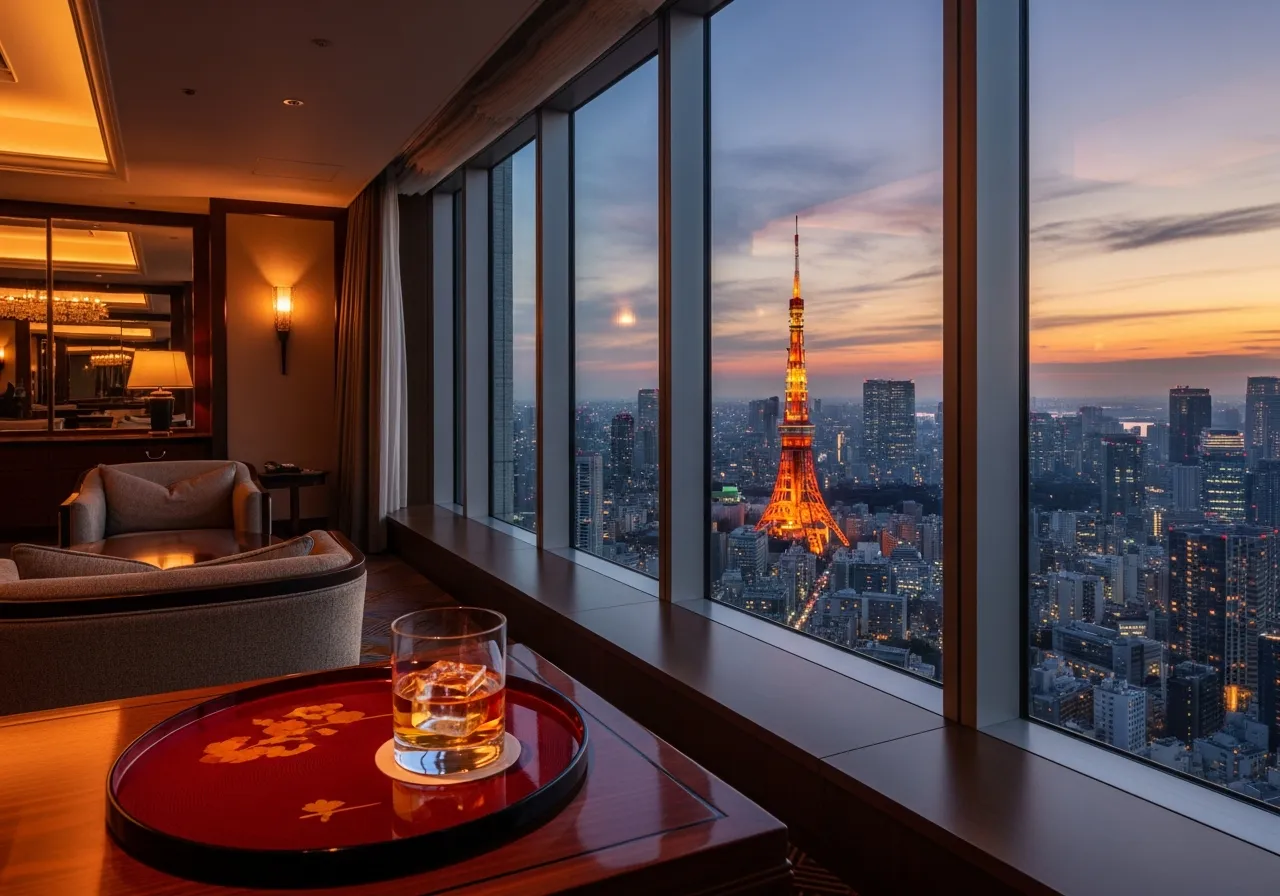
My recommendation: come on a Tuesday or Wednesday. Come alone or with one person. Come after 10 PM, when the early crowd has dispersed and the musicians have loosened and the room reverts to what it was designed to be—a place where you sit with a whisky highball (Suntory Toki with soda, the house preference, and they're right) and look at a city that's too large and too luminous and too alive to comprehend, and you don't try to comprehend it, you just sit with it, and that's enough.
That's always been enough.
The Pool: The 47th Floor, Where Light Becomes Architecture
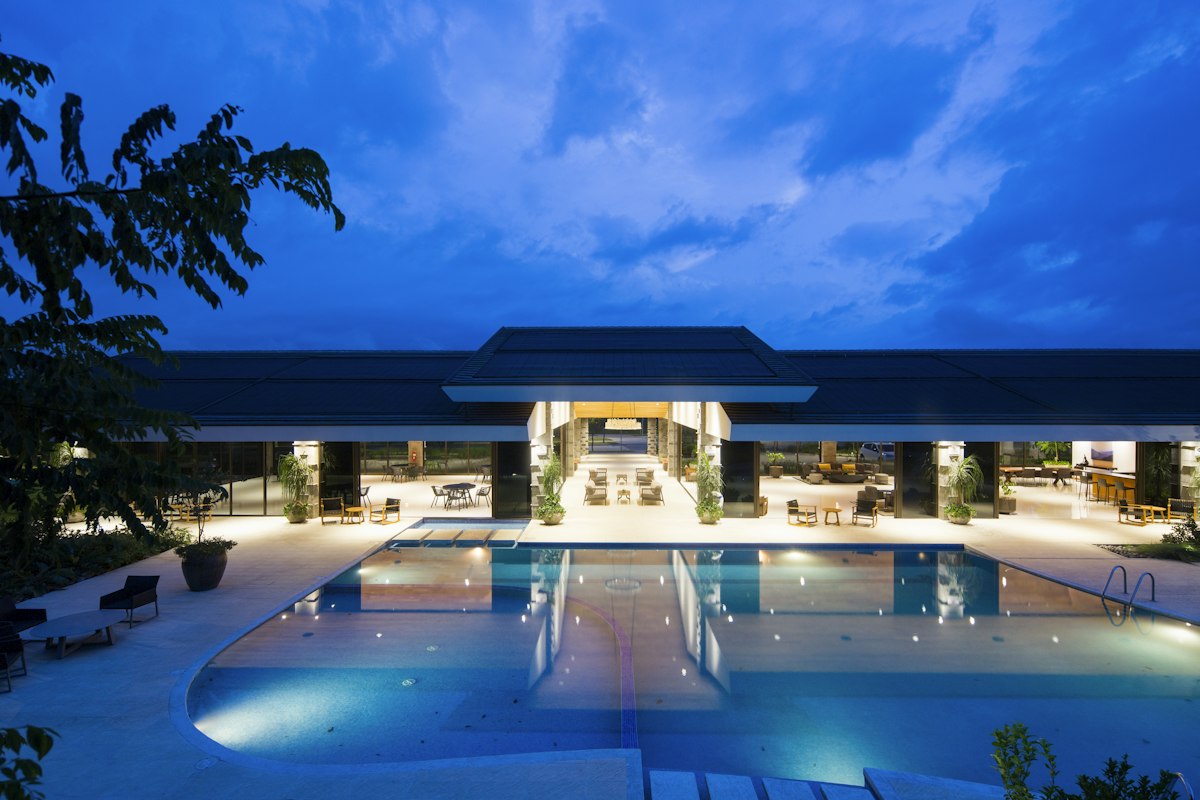
The swimming pool at the Park Hyatt Tokyo is on the 47th floor, and it is the most beautiful hotel pool I've swum in.
I've swum in the Aman New York's 25-meter basement pool. I've swum in the Bulgari Bali's clifftop infinity pool. I've swum in the Corinthia London's steel-lined subterranean pool. I've swum in pools that cost more, pools that are larger, pools with better views, pools with more dramatic settings. The Park Hyatt's pool is 20 meters, indoor, and located in a corporate tower in Shinjuku. It should not be the most beautiful.
It is the most beautiful because of the light.
The pool occupies a room with floor-to-ceiling windows on three sides and a ceiling that's been engineered to filter natural light through a series of glass panels and steel beams in a way that creates a quality of illumination that makes the water glow and the air shimmer and your body, moving through the water, feel like it's participating in something that transcends the category of "hotel amenity."
I swam at 7 AM on a November morning during my most recent stay. The light was grey-gold—November light in Tokyo, filtered through the pool room's glass, touching the water at an angle that made the surface look like liquid metal. I was the only person in the pool. I swam eight laps and then floated on my back and looked at the ceiling and thought about nothing for six minutes, which is longer than I've thought about nothing at any other time in recent memory, and which I credit to the room's design rather than to any personal capacity for mindfulness, because I have very little personal capacity for mindfulness, and the room did the work for me.
The gym, adjacent to the pool, is excellent—Technogym equipment, free weights, a stretching area, and the same quality of light through the same quality of windows. I used it twice. Both times I was distracted by the view while on the treadmill and nearly fell off, which is a review data point I include for completeness.
The spa (Club on the Park, 45th floor) offers treatments that are competent without being revelatory—Swedish massage, shiatsu, facials using Japanese skincare products. The treatment rooms are well-designed but modest compared to the Aman Tokyo's three-floor wellness complex or the Hoshinoya Tokyo's onsen. If spa is your priority, the Park Hyatt is not your hotel. If a pool that makes you believe in architecture is your priority, nothing else comes close.
The Service: Precise, Warm, and Specifically Japanese
I've written about the differences between Japanese, French, British, and American hotel service across multiple guides—Tokyo, Paris, London, New York—and I won't repeat the full taxonomy here. But I need to address what the Park Hyatt does specifically, because its service model is distinct within the Japanese luxury market and because it's the element most likely to determine whether you feel the hotel is worth the rate.
The Park Hyatt's service is precisely warm. This phrase sounds oxymoronic until you experience it: every interaction is calibrated to be both efficient and human, both professional and personal, both structured and spontaneous. The concierge who booked my reservation at a 7-seat sushi counter in Roppongi didn't just make the call; she wrote me a handwritten note explaining the restaurant's ordering system, the chef's preferences, and the most efficient route from the hotel by taxi. This took effort. This took care. This was not required by any operational manual. It was done because doing it well is, for the Park Hyatt's staff, an expression of professional identity.
The housekeeping is extraordinary in the way that Japanese housekeeping is always extraordinary—your shoes turned toward the door, your belongings organized with geometric precision, the bathroom restocked to a standard that suggests the housekeeping team has opinions about towel placement that they've spent years refining. I once left a book open on the nightstand, and the housekeeper placed a bookmark (the hotel's own, leather, monogrammed) at the page I'd been reading. I've never experienced this at any other hotel, and I've stayed at hotels that charge three times as much.
The front desk staff are bilingual (Japanese-English) with a proficiency that extends beyond transactional communication into genuine conversation. During my third stay, I mentioned to the check-in associate that I was visiting Naoshima the following week. She spent five minutes describing her own visit to the Chichu Art Museum, recommended a specific restaurant on the island, and offered to have the concierge arrange my ferry tickets. This conversation was not prompted. It was not part of a service script. It was a person being interested in another person, within the professional context of a hotel check-in, and it made me feel welcome in a way that no amount of marble or thread count can replicate.
For Hyatt Globalist members: the Park Hyatt Tokyo extends Globalist benefits with genuine enthusiasm. Suite upgrades (subject to availability—and availability is tight, because the hotel has only 177 rooms and suites and the upgrade pool is small) are offered without being requested. Breakfast is included (at Girandole, the all-day dining restaurant, or the New York Grill—choose the Grill, always choose the Grill, the ¥6,500 breakfast at the Grill is one of the best Globalist benefits in the entire Hyatt portfolio). Late checkout to 4 PM is honored consistently. The staff know what Globalist means and treat it as a genuine marker of loyalty rather than a corporate obligation.
The Food Program: Beyond the 52nd Floor
The New York Grill dominates the conversation about dining at the Park Hyatt, and I've covered it above. But the hotel has three other restaurants that deserve attention.
Girandole (All-Day Dining, 41st Floor)
Girandole serves breakfast, lunch, and dinner in a high-ceilinged room with western views and the kind of natural light that makes average food look good and good food look exceptional. The breakfast buffet is strong—a mix of Western standards (eggs, pastries, charcuterie) and Japanese offerings (miso, grilled fish, rice, pickles) that, while not at the level of the Four Seasons Otemachi's Japanese set breakfast, is well above average and benefits enormously from the room's design.
The lunch and dinner menus are European-inflected and competent. I wouldn't make a special trip to Girandole—not with Tokyo's restaurant scene operating at this level—but as a hotel dining room for guests who don't want to venture out, it performs its function without embarrassment.
Kozue (Japanese, 40th Floor)
Kozue is the Park Hyatt's Japanese restaurant, and it is the property's most underrated culinary asset. The room is beautiful—a tatami-and-wood space with paper screens and a counter where the sushi chef works with a concentration that makes you lower your voice reflexively. The kaiseki menu is seasonal, traditional, and executed with a seriousness that many standalone Tokyo restaurants would envy. The sashimi—sourced from Tsukiji's outer market—is pristine. The tempura is light, precise, and served at a temperature that suggests the kitchen has an opinion about the thermal window within which tempura should be consumed and is not willing to negotiate.
Dinner at Kozue runs ¥18,000–¥35,000 ($120–$230) per person, which is excellent value for this quality in this city. If you eat one meal at the Park Hyatt that isn't at the New York Grill, eat it here.
The Peak Bar (41st Floor)
The Peak Bar is the hotel's lobby-level cocktail lounge, and it operates in the considerable shadow of the New York Bar upstairs. It's quieter, less famous, less crowded, and serves cocktails that are frankly just as good—the bartender on my last visit made an old fashioned with a single sphere ice cube and Suntory Hakushu 12 that was the best old fashioned I've had in a hotel bar this year, and I've drunk at the Connaught Bar and Bemelmans in the past twelve months.
The Peak Bar is where I'd go if I were visiting the Park Hyatt for the first time and wanted the atmospheric experience of the hotel without the tourist density of the New York Bar. It's the insider's bar, and I'm telling you about it because that's what reviews are for.
The Competition: What the Park Hyatt Is Up Against
I ranked the Park Hyatt third in the Tokyo luxury hotel guide, behind the Aman Tokyo and the Four Seasons Otemachi. Let me explain that ranking with more specificity than the guide allowed.
vs. Aman Tokyo: The Aman is a different animal—71+ sqm suites, a three-floor spa, the particular silence that Aman properties deploy as a philosophical weapon. The Aman costs 2.5x the Park Hyatt's rate and delivers a proportionally more immersive experience. If money is not a variable, the Aman is the better hotel. If money is a variable—and money is always a variable, even for the wealthy—the Park Hyatt offers 85% of the atmospheric quality at 40% of the price, which is the best ratio in Tokyo luxury hospitality.
vs. Four Seasons Otemachi: The Four Seasons is newer (2020), more polished, and has a food program that's objectively stronger—est is a better restaurant than the New York Grill. The Four Seasons also has better rooftop views and a more contemporary design sensibility. What the Park Hyatt has over the Four Seasons is character—the Tange architecture, the Nakashima-inspired furniture, the pool, the jazz, the weight of thirty years of accumulated guest experience. The Four Seasons is a brilliant hotel. The Park Hyatt is an institution. Whether you want brilliance or institutional weight determines your choice. Both choices are correct.
vs. Peninsula Tokyo: The Peninsula is more technologically sophisticated and more traditionally luxurious. It's also more formal. The Park Hyatt's advantage over the Peninsula is altitude—being on the 39th–52nd floors gives the Park Hyatt a verticality that the Peninsula's lower-rise structure can't match.
vs. Hoshinoya Tokyo: The Hoshinoya is a ryokan in a tower. Comparing it to the Park Hyatt is like comparing a haiku to a novel—both are literature, but operating in different forms. If you're choosing between them, the question isn't "which is better?" but "what kind of experience do you want?"
The Cost: What You'll Actually Spend
The Park Hyatt Tokyo's rates range from ¥120,000/night ($800) for a Park Room in low season to ¥260,000/night ($1,700) for a Park Suite in peak season. Here's a three-night stay, honestly modeled:
| Category | Cost |
|---|---|
| Park Room, 3 nights (average rate) | ¥420,000 ($2,800) |
| Tax & Service (15%) | ¥63,000 ($420) |
| Breakfast at New York Grill (3 mornings, 1 person) | ¥19,500 ($130) — free with Globalist |
| Dinner at New York Grill (1 evening, 2 persons, wine) | ¥55,000 ($370) |
| Dinner at Kozue (1 evening, 2 persons) | ¥50,000 ($330) |
| Drinks at New York Bar (2 evenings) | ¥14,000 ($93) |
| Pool/Gym Access | Complimentary |
| Total (non-Globalist) | ¥621,500 ($4,143) |
| Total (Globalist, with breakfast included) | ¥602,000 ($4,013) |
The Park Hyatt is also bookable on Hyatt points at approximately 40,000–50,000 points per night (Category 8, dynamic pricing). For travelers with significant World of Hyatt balances, a three-night points stay represents one of the strongest redemption values in luxury hospitality globally—40,000 points per night at a hotel charging $800+ in cash is a cents-per-point valuation north of 2.0, which is excellent by any loyalty program standard.
What Doesn't Work
The movie crowd. There are nights, particularly weekends and during cherry blossom season, when the New York Bar feels less like a hotel lounge and more like a tourist attraction with a drink minimum. The staff manage this gracefully, but the atmospheric consequence is real.
The location is Shinjuku. Shinjuku is extraordinary—but it's not central in the way that Marunouchi (Four Seasons, Peninsula, Palace Hotel) or Otemachi (Aman, Hoshinoya) are central. You're a 15-minute taxi from Ginza, 20 minutes from Roppongi, 25 minutes from Asakusa. Evening plans require logistics that hotels near Tokyo Station don't require.
The spa is adequate, not excellent. The Aman's spa is world-class. The Hoshinoya's onsen is unique. The Four Seasons' spa is very good. The Park Hyatt's spa is fine—professional treatments in professional rooms. For a hotel that excels at creating emotional experiences, the spa's competence reads as a missed opportunity.
Some rooms need the next renovation. Certain rooms—particularly on lower floors and north-facing—show wear. Carpet edges. Soft furnishing fatigue. Request a high floor. Request a west-facing room. These are reasonable requests, and the front desk handles them with accommodating precision.
Who Should Stay Here
The first-time Tokyo visitor who wants a classic. The Park Hyatt is the most recognizable luxury hotel in Tokyo, and its recognition is earned. Starting your Tokyo relationship here—with the pool, the Grill, the bar, the Shinjuku views—establishes a baseline of quality against which every future stay will be measured. It's the Claridge's of Tokyo: the hotel that defines the category.
The Hyatt loyalist. If you have Globalist status or significant World of Hyatt points, the Park Hyatt Tokyo is one of the five best redemption opportunities in the entire Hyatt portfolio. Suite upgrade potential, complimentary breakfast at the New York Grill, and 4 PM late checkout transforms a $800/night hotel into extraordinary value.
The film pilgrim (but only if you're actually ready). The Park Hyatt is better than your projection of it. Stay long enough to discover the actual hotel beneath the cinematic one. Go to Kozue. Swim at 7 AM. Find the Peak Bar. The New York Bar is magnificent—but so is everything else.
The repeat visitor who's done everything else. The Park Hyatt occupies a register that the newer hotels don't—warmer than the Aman, more atmospheric than the Four Seasons, more vertical than the Peninsula. It's the hotel that Tokyo loves, and Tokyo's love is not given casually.
Who Should Not Stay Here
People who need a spa-forward stay. If wellness is your priority, choose the Aman Tokyo (three-floor spa complex), the Hoshinoya Tokyo (natural hot spring onsen), or the Six Senses in Bali. The pool is transcendent. The spa is not.
People who want a central location for sightseeing. If your itinerary centers on Asakusa, the Imperial Palace, Ginza, or the museum district in Ueno, a Marunouchi hotel will save you 30–60 minutes of daily transit.
People who can't tolerate a glass bathroom partition. The bathroom is visible from the bedroom through a glass panel. There is a blind. The blind is effective. But the knowledge that the bathroom is architecturally exposed may create a psychological discomfort for certain guests. I found it freeing. Your mileage may vary.
The Verdict
The Park Hyatt Tokyo is not the best hotel in Tokyo. The Aman is more luxurious. The Four Seasons Otemachi is more polished. The Hoshinoya is more culturally immersive. Several properties have newer rooms, better spas, stronger food programs.
The Park Hyatt Tokyo is the most beloved hotel in Tokyo, and "beloved" is a word I don't use lightly in luxury travel criticism because it implies a relationship that goes beyond the transactional—an accumulation of experiences, returns, and the particular loyalty that develops between a guest and a hotel when the hotel has been consistently, reliably, structurally good for thirty years.
The pool at 7 AM. The whisky at the New York Bar at 10 PM. Kozue's tempura at lunch. The view of Fuji on a November morning when the air is cold and clear and the mountain appears like a promise that the world, despite everything, is still capable of producing something perfect.
These are not experiences you can design from a brief. They're experiences that accumulate over decades—layer by layer, guest by guest, season by season—until the hotel becomes not just a place to stay but a place to return to, which is the highest function a hotel can serve and the rarest thing it can become.
Final Score: 9.1/10
The same score I gave it in the Tokyo ranking. The score of a hotel that's no longer the best in its city but remains, stubbornly and beautifully, the one I'd miss most if it were gone.
I'll be back in October. I'll sit at the New York Bar on a Tuesday. I'll order the Suntory highball. I'll look at the skyline and feel the same thing I felt in 2009—that the world is larger than whatever I'm anxious about, and that a hotel room 177 meters above Shinjuku is a perfectly good place to remember that.
Sofia Coppola understood this. She just got there first.
FAQ
Is the Park Hyatt Tokyo the hotel from Lost in Translation?
Yes. The film was primarily shot at the Park Hyatt Tokyo in 2002, using the New York Bar, the pool, the lobby, and various rooms and corridors. The hotel doesn't aggressively market the connection but doesn't deny it either—the staff will answer questions about the film with polite enthusiasm. The New York Bar looks essentially the same as it did in the movie, though the crowd composition has shifted toward visitors specifically there for the film.
How much does the Park Hyatt Tokyo cost per night?
Rates range from approximately ¥120,000 ($800) per night for a Park Room in low season to ¥260,000 ($1,700) for a Park Suite in peak season (March–April cherry blossom, October–November autumn foliage). The hotel is also bookable on World of Hyatt points at approximately 40,000–50,000 points per night, representing one of the best luxury hotel points redemptions globally.
Is the Park Hyatt Tokyo still worth it compared to newer hotels?
Yes—with the understanding that "worth it" now means something different than it did in 2003. The Park Hyatt is no longer the unchallenged best luxury hotel in Tokyo (the Aman Tokyo and Four Seasons Otemachi have both surpassed it in specific dimensions). What it retains—the pool, the New York Bar, the Kenzo Tange architecture, thirty years of accumulated character—is not replicable by newer properties, which makes it irreplaceable in a way that "better" hotels are not.
Can I visit the New York Bar without staying at the hotel?
Yes. The New York Bar is open to non-guests, with a cover charge of ¥2,800 ($19) per person after 8 PM (when live music begins). Reservations are recommended for weekends and essential during cherry blossom season. Arrive before 8 PM to avoid the cover charge and to secure a window seat, which is the seat you want and which everyone else also wants.
What is the best room type at the Park Hyatt Tokyo?
The Park Deluxe Room (55 sqm, corner position) offers the best combination of space, light, and view for the price—the dual-aspect windows give you both Shinjuku skyline and a wider panorama than the standard Park Room's single orientation. If budget allows, the Park Suite (100 sqm) is one of the finest hotel suites in Tokyo. For Hyatt Globalist members, requesting the suite upgrade at check-in is worth the attempt—the front desk is genuinely accommodating when availability permits.
Eleanor Vance is a Contributing Editor at riiiich.me who first stayed at the Park Hyatt Tokyo during a period of personal upheaval and has returned three times since, each time slightly less upheaveled and slightly more convinced that the 47th-floor pool is the best room in Tokyo. She has seen Lost in Translation twenty-two times—fourteen during her divorce, three at the Park Hyatt itself, and five on various first-class flights where the selection felt cosmically appropriate. Her Tokyo dining guide is available for those who want restaurant recommendations from someone who once cried into a bowl of ramen in Golden Gai and considers it one of the formative culinary experiences of her life. It was good ramen. It was a good cry.
Related reading: Address Beach Resort Dubai Review 2026: Is It Worth $510 a Night?, Aman New York Review 2026: I Spent $38,000 on 7 Nights. Here''s Whether It''s Worth It., Aman Tokyo Review: The Vertical Sanctuary That Actually Deserves the Myth, Armani Hotel Dubai Review 2026: Inside the Burj Khalifa, Worth $700?, Atlantis The Royal Dubai Review 2026: Is It Worth $1,400 a Night?, Atlantis The Royal vs Burj Al Arab 2026: Which Dubai Icon Is Worth Your Money?, 8 Best 5-Star Hotels in Dubai 2026: Ranked by Real Value, Best Luxury Beach Hotels in Dubai in 2026, Ranked, Best Brunch in Dubai 2026: 23 Friday Brunches Ranked by Someone Who''s Done All of Them, 7 Best Business Hotels in Dubai 2026: Ranked for Executive Travel, Amex Platinum vs Chase Sapphire Reserve vs Centurion 2026: Which Luxury Travel Card Wins, 8 Best Dubai Hotels for Couples & Honeymoons 2026: Romance Ranked, 7 Best Dubai Hotels for Families in 2026: Ranked by Someone Who Brings Their Kids, Sony vs Bose vs AirPods Max 2026: Which Travel Headphone Actually Wins, 10 Best Hotel Suites in Dubai 2026: Ranked From $1,340 to $38,000/Night, The 50 Best Hotels in the World 2026: City-by-City Rankings, 10 Best Hotels in Maldives 2026: A 23-Visit Perfectionist's Rankings, 7 Best Hotels Near Burj Khalifa Dubai 2026: Ranked by Distance & Fountain Views, Best Luxury Hotels in Bali 2026: Ranked After 11 Stays Across the Island ($450–$3,800/Night), Best Luxury Hotels in London 2026: Ranked After 16 Stays (£800–£4,000/Night), Best Luxury Hotels in New York 2026: Ranked After 19 Stays ($1,100–$5,200/Night), Best Luxury Hotels in Paris 2026: Every Palace Hotel Ranked After 14 Stays (€1,200–€4,500/Night), Best Luxury Hotels in Tokyo 2026: Ranked After 12 Stays (From ¥65,000 to ¥480,000/Night), Best Restaurants in Dubai 2026: A 47-Restaurant Ranking by Someone Who Ate at Every Single One, 60 Best Restaurants in the World 2026: Tokyo to Dubai Ranked, Best Rooftop Bars in Dubai 2026: 19 Bars Ranked by a Man Who''s Closed All of Them, Best Spas in Dubai 2026: 15 Treatments Ranked by a Woman Who Cried at Three of Them, 8 Best Watches Under -10,000 2026: Smart Money's Guide, Best Watches Under -10,000 for Men - 8 Picks for Every Budget, How to Book Dubai Luxury Hotels With Points and Miles in 2026: The Honest Guide, Book First Class with Points 2026: The Complete Sweet Spot Guide, Bulgari Resort Dubai Review 2026: Is $1,100/Night Worth It?, Burj Al Arab Review 2026: Is $2,500/Night Worth It?, Cayenne vs Range Rover 2026: Turbo GT vs Autobiography Comparison, Cost of Owning a Ferrari in 2026: The Real Annual Numbers (From an F8 Tributo Owner), Datejust vs. Submariner: The Two-Rolex Problem and the Wrist I Can''t Decide, Dubai Luxury Hotel Prices 2026: What $500 vs $1,000 vs $2,500 a Night Actually Gets You, What It Actually Costs to Stay at a Luxury Hotel in Dubai in 2026, Dubai Mall vs Mall of the Emirates 2026: A Luxury Shopper''s Honest Comparison (After Spending AED 340,000 Between Them), Dubai Travel Budget 2026: What a Week Actually Costs at Every Level (From $1,800 to $47,000), Dubai vs Abu Dhabi for Luxury Travel 2026: The Honest Comparison After 31 Trips Between Them, >-, First Class Cost Every Airline: 47 Flights, 23 Airlines, the Real Price Data, Your First Luxury Trip to Dubai: Complete Planning Guide for 2026, Four Seasons Dubai DIFC Review: Is It Worth $650 a Night in 2026.